.avif)
The Spice Must Flow


.png)

While the industry was still processing lessons from traditional supply chain attacks, a new kind of threat emerged from the npm ecosystem. Not content with the typical one-and-done approach of previous campaigns, this attack introduced something we'd never seen before: autonomous replication. Meet Shai-Hulud, the sandworm that doesn't just consume - it reproduces.
This isn't another story about phished credentials or compromised packages. This is about the moment software supply chain attacks evolved from surgical strikes to self-sustaining organisms. And every organization that builds software is now living in the aftermath of that evolution.
The Perfect Predator: Anatomy of a Digital Sandworm
Shai-Hulud represents a fundamental shift in how attackers think about persistence and scale. Traditional supply chain attacks require constant human intervention; compromise an account, poison a package, hope for downloads. Shai-Hulud eliminated the middleman.
The Bait (T1566 - Phishing) Like the desert nomads who learned to walk without rhythm, the attack began with careful misdirection. A developer received what appeared to be a legitimate npm security alert, requesting credential verification. One compromised account became the patient zero for what would become the first self-replicating worm in the npm ecosystem.
The Awakening (T1087, T1552 - Discovery & Credential Access) Once installed via a malicious post-install script, Shai-Hulud deployed TruffleHog to scan for secrets. The worm systematically downloaded the latest TruffleHog release, automatically detecting the correct version for the victim's operating system, then spawned child processes to scan the local filesystem for high-entropy strings, keys, and sensitive secrets. GitHub tokens, npm credentials, AWS keys, GCP credentials, and cloud service tokens - everything needed to expand its reach exponentially.
The Tasting (T1555, T1552.001 - Credential Theft) The worm didn't just collect credentials - it validated them. Testing npm tokens with the /whoami endpoint, verifying GitHub access, ensuring each stolen key could serve its reproductive mission. Like a sandworm testing the vibrations in the sand, it confirmed each pathway before striking.
The Spawning (T1550.001 - Application Access Token Abuse) Here's where Shai-Hulud transcended traditional malware. Using stolen npm tokens, it automatically identified other packages under the same maintainer's control, injected malicious code, and published new compromised versions. No human operator required. The worm had learned to ride the rhythm of the ecosystem.
The Spreading (T1567.001, T1199 - Code Repository Abuse) The worm created public GitHub repositories named "Shai-Hulud" under victims' accounts, dumping stolen secrets in triple-base64-encoded JSON files. But the sophistication didn't stop there, it also pushed malicious GitHub Actions workflows to all accessible repositories. These workflows systematically collected and exfiltrated repository secrets via HTTP requests to the attacker-controlled webhook endpoint, ensuring persistence across the entire development lifecycle.
The Devouring (T1020 - Automated Exfiltration) In perhaps its most sophisticated move, Shai-Hulud leveraged GitHub's REST API to automate lateral movement. Using specific API requests like /user/repos?affiliation=owner,collaborator,organization_member&since=2025-01-01T00:00:00Z&per_page=100, it identified repositories where compromised accounts had adequate privileges, filtering by owner, collaborator, or organization member roles and focusing on recent activity. The worm then migrated private organizational repositories to public personal accounts under attacker control, tagged with "Shai-Hulud Migration" descriptions and a -migration suffix. This wasn't just data theft - it was systematic intellectual property exposure, making private source code and embedded secrets publicly accessible.
The API Attack Vector: Where Traditional Security Goes Blind
Shai-Hulud's entire operation relied on legitimate API interactions. npm registry APIs for package publishing. GitHub APIs for repository creation. Webhook services for data exfiltration. Every transaction appeared authorized because technically, it was.
Traditional security tools failed catastrophically because they weren't designed to distinguish between legitimate and malicious API usage when the credentials are valid. Your endpoint protection might catch malware, but it won't stop authorized API calls that happen to be serving malicious purposes.
This is where the paradigm shift becomes unavoidable. The attack surface isn't just your applications anymore - it's every API interaction, every dependency relationship, every trust boundary in your software supply chain.
How Context-Aware API Security Changes Everything
This is precisely the scenario where Traceable’s approach would have fundamentally altered the attack's trajectory. Let me show you how comprehensive API security transforms each phase of the Shai-Hulud campaign from successful exploitation to detected and blocked activity.
Behavioral Anomaly Detection: Spotting the Worm Early
Unusual API Pattern Recognition: Traceable's behavioral analysis would have immediately flagged the systematic package enumeration and publishing patterns. When npm tokens start rapidly publishing updates across multiple packages in short succession, that's not normal developer behaviour, that's automated attack behaviour.
TruffleHog Integration Monitoring: The deployment and execution of TruffleHog for credential scanning would have triggered anomaly alerts. Legitimate developers don't typically run enterprise-grade secret scanning tools during package installation.
GitHub API Abuse Detection: The automated creation of multiple "Shai-Hulud" repositories, the systematic injection of malicious workflows into yaml files, and the mass migration of private repositories to public accounts would have been detected as highly abnormal GitHub API usage patterns. Traceable would have specifically flagged the API requests like /user/repos?affiliation=owner,collaborator,organization_member&since=2025-01-01T00:00:00Z&per_page=100 used for repository enumeration and the subsequent automated branch creation and workflow injection activities.
Webhook Exfiltration Monitoring: The systematic data exfiltration to webhook.site/bb8ca5f6-4175-45d2-b042-fc9ebb8170b7 would have been detected and blocked, preventing credential theft from reaching attacker infrastructure. The webhook eventually became non-functional due to excessive activity, demonstrating the volume of data being exfiltrated.
Real-Time Threat Mitigation
NPM API Rate Limiting & Alerting: When Traceable detected the automated package publishing behavior through npm API monitoring, it could have triggered immediate alerts to security teams with detailed context about the anomalous publishing patterns, enabling rapid manual intervention to investigate and potentially revoke compromised npm tokens.
GitHub API Monitoring & Alerting: The systematic repository enumeration, malicious workflow injection, and repository migration activities would have generated immediate alerts with complete API call context, allowing security teams to quickly identify the scope of compromise and take appropriate action.
Webhook Traffic Detection: The systematic data exfiltration to webhook.site/bb8ca5f6-4175-45d2-b042-fc9ebb8170b7 would have been detected through API traffic analysis, providing security teams with immediate visibility into the data exfiltration attempt and the specific webhook endpoints being used.
Comprehensive Attack Reconstruction
Complete API Transaction History: Traceable's data lake would have captured every API call made during the attack across npm, GitHub, and cloud services, providing complete forensic visibility into which packages were compromised, what API endpoints were abused, and how the worm propagated through API interactions.
Cross-Platform API Correlation: By monitoring APIs across npm, GitHub, and cloud services, Traceable could have correlated the attack across all affected platforms, showing the complete scope of API-based compromise and the relationships between different attack phases.
The Evolution of Cyber Warfare: From Heists to Ecosystems
The Shai-Hulud incident exposes an uncomfortable truth: your software supply chain is now a battlefield, and every dependency is a potential weapon. The attack didn't just steal credentials, it weaponized the trust relationships that make modern software development possible.
What makes Shai-Hulud different isn't just its technical sophistication, it's the strategic thinking behind it. Previous supply chain attacks were essentially digital heists: get in, steal what you can, get out. Shai-Hulud represents ecosystem warfare.
By creating a self-sustaining attack that reproduces across the npm ecosystem, the attackers achieved something unprecedented: a threat that continues to evolve and spread without ongoing human intervention. Each new victim becomes a vector for further propagation, creating a threat landscape that traditional incident response can't contain.
This is the future of supply chain attacks: not surgical strikes, but digital organisms designed to thrive in the interconnected environments that power modern software development.
When your applications live in APIs, your security must live there too.
This means:
Behavioral API Monitoring: Understanding normal vs. abnormal API usage patterns across your entire development ecosystem, focusing on call frequencies, sequences, and cross-platform correlations.
API Traffic Analysis: Monitoring API interactions across npm, GitHub, cloud services, and other development platforms to detect coordinated attack patterns.
Real-Time API Anomaly Detection: Identifying when legitimate credentials are being used for automated, non-human API interactions that indicate potential compromise.
Cross-Platform API Correlation: Connecting suspicious API activity across different services to understand the full scope of coordinated attacks.
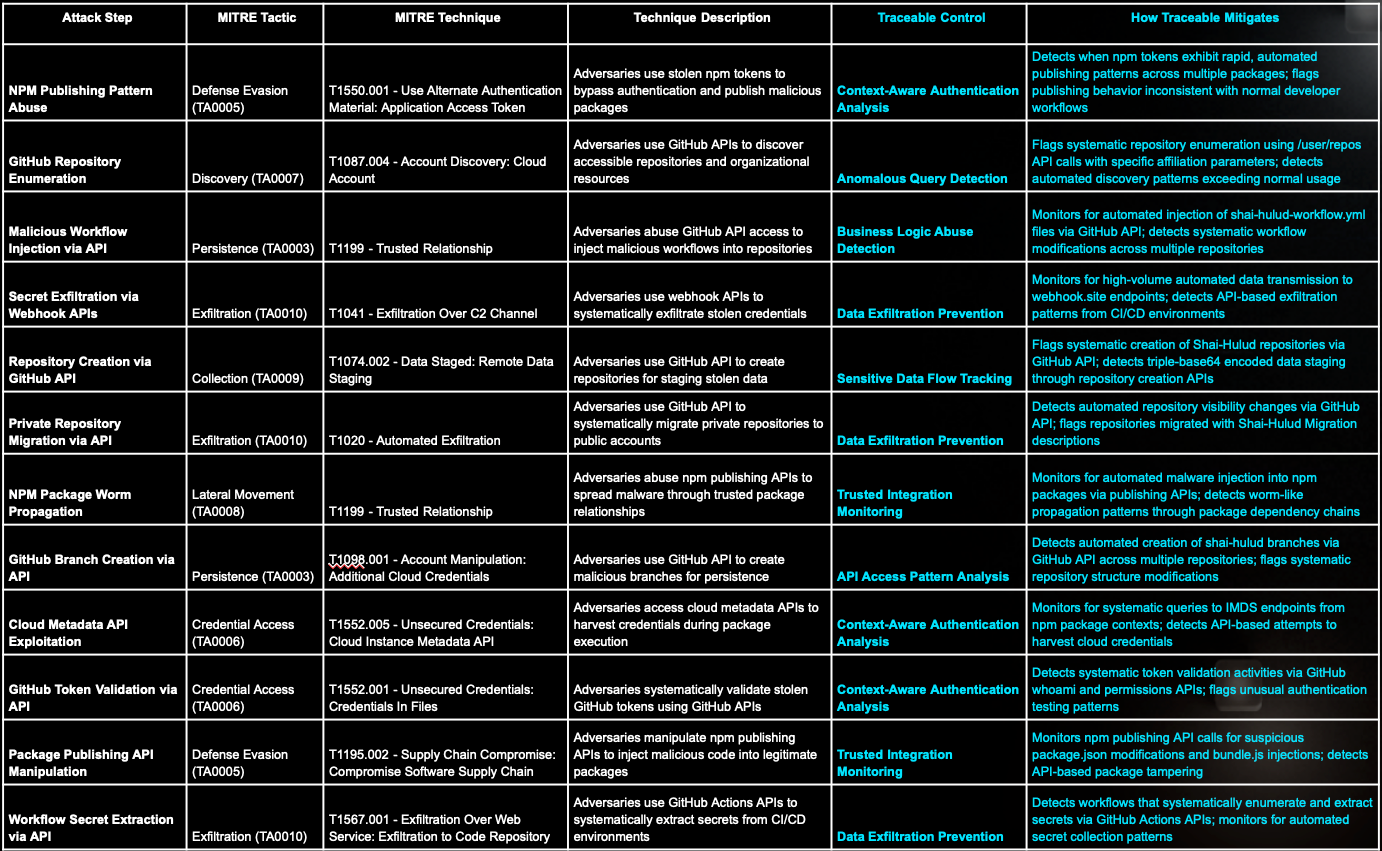
MITRE ATT&CK Ref.
A step-by-step breakdown of the techniques used in the breach, and how Traceable's context-aware platform transforms every one into a detection opportunity.
The Inside Trace
Subscribe for expert insights on application security.


.webp)